• My D&D Campaign Finally Started Breathing on Its Own

    How a Cute Little Robot In Distress Nearly Killed My Entire Party

    We officially made it to Day 2 of my cyberpunk D&D campaign set in Iceland in the year 2136 after a much needed long rest.

    For the first time since starting the campaign, the party woke up with no train cars collapsing around them, no immediate combat encounter, and no giant narrative emergency forcing them in a specific direction.

    Which meant something terrifying happened instead:

    They were free.

    And apparently the first thing free people do in the Neon Plane is go get pizza. At 9am.

    The session started with the group deciding to walk across the street to a place called Slices, a pizza shop run by a Jersey-sounding hobgoblin named Cutter.

    Simple enough.

    Except the second the party crossed into the alleyway between buildings, my players immediately became suspicious because I switched the Foundry map from the normal neighborhood view to a much more zoomed-in detailed alley map.

    Veteran D&D players truly have the survival instincts of abused raccoons.

    I unhid a small token:
    a cute little robot in distress.

    Of course this was just a reskinned version of the classic “creature in distress” trap that experienced players should absolutely know better than to interact with.

    Naturally, they interacted with it immediately.

    Our seven-foot-tall warforged Paladin, Golgor, decided he wanted to carry the robot with the party, while our female synth warlock started scavenging the alley looking for something to strap it onto his back with. They thought they were getting one up on me by “breaking the game”. Lol.

    At one point she attempted to break into a parked vehicle for supplies. She rolled high enough on Sleight of Hand to avoid setting off the alarm, but still failed the actual attempt. The image of a sexy robot delicately trying to commit quiet car theft in a dark alley absolutely destroyed all of us at the table.

    Eventually she found some straps in a nearby trash can and started improvising some makeshift harness.

    And the second they picked the Wall-E sized robot up…

    Its eyes turned red.

    Combat started immediately.

    I had designed this thing to be incredibly aggressive. Grapple-hungry. High pressure. Constant engagement. But the real surprise came from a feature I added almost as a joke while building it a few hours before session start:

    Self-destruct.

    At the end of the fight, the robot had nearly wiped the entire four-player group.

    Two party members were left barely standing at around 7 HP while the other two were fully downed after the robot detonated for 4d10 fire damage in a massive explosion.

    The only reason the campaign didn’t become a smoking crater in an alleyway on Day 2 was because half the party managed to pass their Dexterity saves.

    I’m still laughing about it.

    And honestly, I think that encounter taught the players something extremely important about the world:
    just because something looks cute does not mean it’s safe.

    Once the smoke cleared, the survivors limped into Slices and finally met Cutter properly.

    This also became the party’s first short rest of the campaign, which weirdly felt like a bigger milestone than some combats I’ve run. Everyone relaxed. The tension dropped. The group started feeling less like passengers surviving disasters and more like actual people inhabiting the district.

    Our Shadow monk, Grin, bought his first knife so he could start fulfilling his Joker-cosplay fantasy.

    The group got food.

    They talked.

    No world-ending stakes. No combat music (switched to ambient lo-fi). Just recovery and conversation.

    And honestly?
    That stuff matters more than I expected.

    Afterward, the party decided to continue exploring Lantern Docks and eventually wandered into Chrome Heart, the neighborhood cyberware and augmentation clinic.

    This became their first real exposure to the homebrew augmentation systems I’ve been building for the campaign. Most of the upgrades were definitely outside their budget, which honestly helped the world feel more believable, and kept them from biting off more than they can chew too early. The players immediately started mentally cataloging future goals instead of simply buying power upgrades immediately.

    Then came one of my favorite moments of the night.

    One of the players decided to use his in-game phone to look up reviews for a nearby coffee shop.

    Now, under normal circumstances, this would be a completely insignificant moment.

    But because he’s an enormous armored robot built like a walking refrigerator, I made him roll Sleight of Hand to type on the tiny device.

    He rolled a 10.

    Which instantly evolved into all of us roleplaying him struggling to type things like:

    “lcoal cofdee ner mee”

    The entire table lost it.

    The party eventually arrived at the coffee shop and met the owner/barista, a highly perceptive information broker who was specifically designed to recognize the players as the “heroes” from the train incident and potentially offer them their next narrative hook.

    Unfortunately, one of the party members immediately tried lying to him.

    Which went poorly.

    The NPC became suspicious almost immediately and emotionally closed off from the interaction. The players unknowingly talked themselves out of what was supposed to be a clean quest hook.

    But one of the other party members tipped him generously on the way out, and I had him give her a subtle wink before they left.

    So now that thread is still alive.

    Just damaged.

    Which honestly feels far more interesting than if everything had gone according to plan.

    Finally, the group headed down to the docks to meet back up with Koji, the party’s recurring DM PC:
    a female tabaxi Kensei monk modeled directly after my girlfriend’s and my cat.

    This led into one of the most enjoyable stretches of pure roleplay we’ve had so far before Koji directed the group toward the next major event in the district:
    an underground street race.

    And not just a background event.

    An actual fully-built mini-game.

    Custom racer tokens.
    Movement systems.
    Betting mechanics.
    Potential sabotage.
    Crowds.
    Bookmakers.
    Chaos.

    By the end of the night, the players were standing at the edge of a neon-soaked Fast & Furious-inspired race scene (with 24’s by T.I. as the background music) packed with spectators, engines screaming through the docks while people shouted odds and exchanged money under flickering lights.

    That’s where we ended the session.

    And honestly, the biggest realization I had tonight wasn’t about combat balance or encounter design.

    It was about prep.

    I’m only about a month into DMing, but I’ve already noticed something massive changing in how I prepare sessions.

    My early notes were gigantic.
    Miles long.
    Overwritten.
    Overplanned.
    Trying to anticipate every possible thing the party could do.

    Now?

    My prep is getting shorter.

    Not because I care less.

    But because I’m finally starting to understand what experienced DMs mean when they say:

    “Let the players tell the story.”

    The trick isn’t writing a railroad.

    It’s building a world dense enough that the players can collide with interesting things naturally.

    A suspicious alley.
    A fake distress robot.
    A pizza shop.
    A coffee conversation gone awkward.
    A street race.

    That’s all tonight really was.

    And somehow it became one of the most memorable sessions we’ve had so far.
  • My Players Completely Steamrolled the “Boss Fight” I Spent Weeks Designing

    And Honestly? It Taught Me More Than If It Had Worked.

    The third session of my cyberpunk D&D campaign was supposed to be simple in structure.

    Get the players off the train that they started the campaign on.

    That was it.

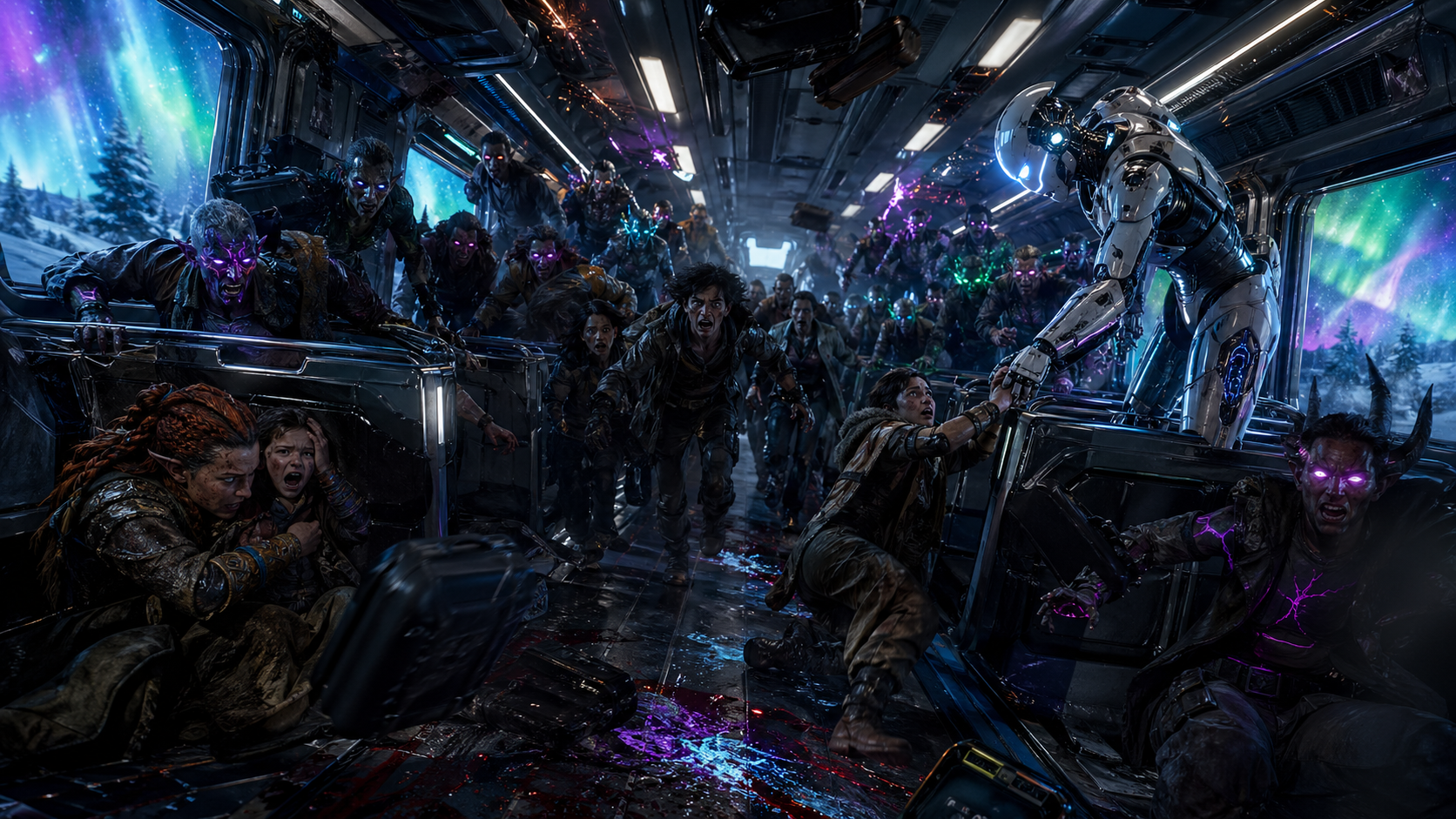
    Three sessions of claustrophobic tension, infected passengers, collapsing train cars, desperate civilians, dwindling resources, and slowly escalating horror aboard a maglev rail line cutting through the frozen neon sprawl of Iceland in the year 2136.

    Everything had been building toward the final sequence.

    The boss fight.

    Or at least… what I thought was supposed to be one.

    I had spent weeks designing the final train car encounter. Three separate hordes. High HP pools. High damage output. Multi-attack. Status effects specifically engineered to cripple the players’ action economy. The entire fight was built around overwhelming pressure and attrition.

    On paper, it was brutal.

    At the table?

    The party absolutely annihilated it.

    Not “barely survived.” Not “won creatively.”

    I mean they completely dismantled the encounter before the enemies landed a single hit.

    Not one.

    I’ll repeat: three hordes. Multi-attack. Crippling status effects. Zero damage dealt.

    Part of it was genuinely awful luck on my end. I rolled two nat-1’s on their turns and just whiffed at our party’s level 2 monk with a 17 AC. Meanwhile my players were hitting everything, succeeding on saves, positioning perfectly, and operating like a coordinated military unit instead of a bunch of exhausted idiots trapped aboard a death train.

    But the deeper truth is this:

    I fundamentally underestimated what eight players acting together are capable of.

    Three hordes of 30 enemies each sounds terrifying until you realize the players are still taking eight coordinated turns before most enemies can meaningfully respond.

    The train car itself also worked against me. I accidentally created a bottleneck that turned the battlefield into a meat grinder in the players’ favor. The hordes couldn’t pressure from multiple angles. The party could focus fire efficiently. Crowd control stacked harder than I expected. And once momentum shifted, the encounter collapsed almost instantly.

    I’d be lying if I said it didn’t sting a little.

    As a DM, there’s a weird emotional whiplash that happens when the cinematic nightmare sequence you envisioned gets converted into a tactical speedrun by a party rolling hot at exactly the wrong time.

    But honestly?

    The players loved it.

    And more importantly, it taught me something I needed to learn early:

    Large D&D parties are not fighting monsters anymore.

    They are fighting systems.

    Adding more HP isn’t the answer. Bigger numbers aren’t the answer. What large groups actually struggle against is layered pressure:

    • action denial
    • environmental hazards
    • split objectives
    • reinforcements
    • movement disruption
    • timers
    • uncertainty

    The next time I build a set piece encounter, I’m thinking less about “how much damage can this enemy do?” and more about:

    “How many simultaneous problems can the battlefield create?”

    Ironically, the most memorable part of the session ended up not being the combat at all.

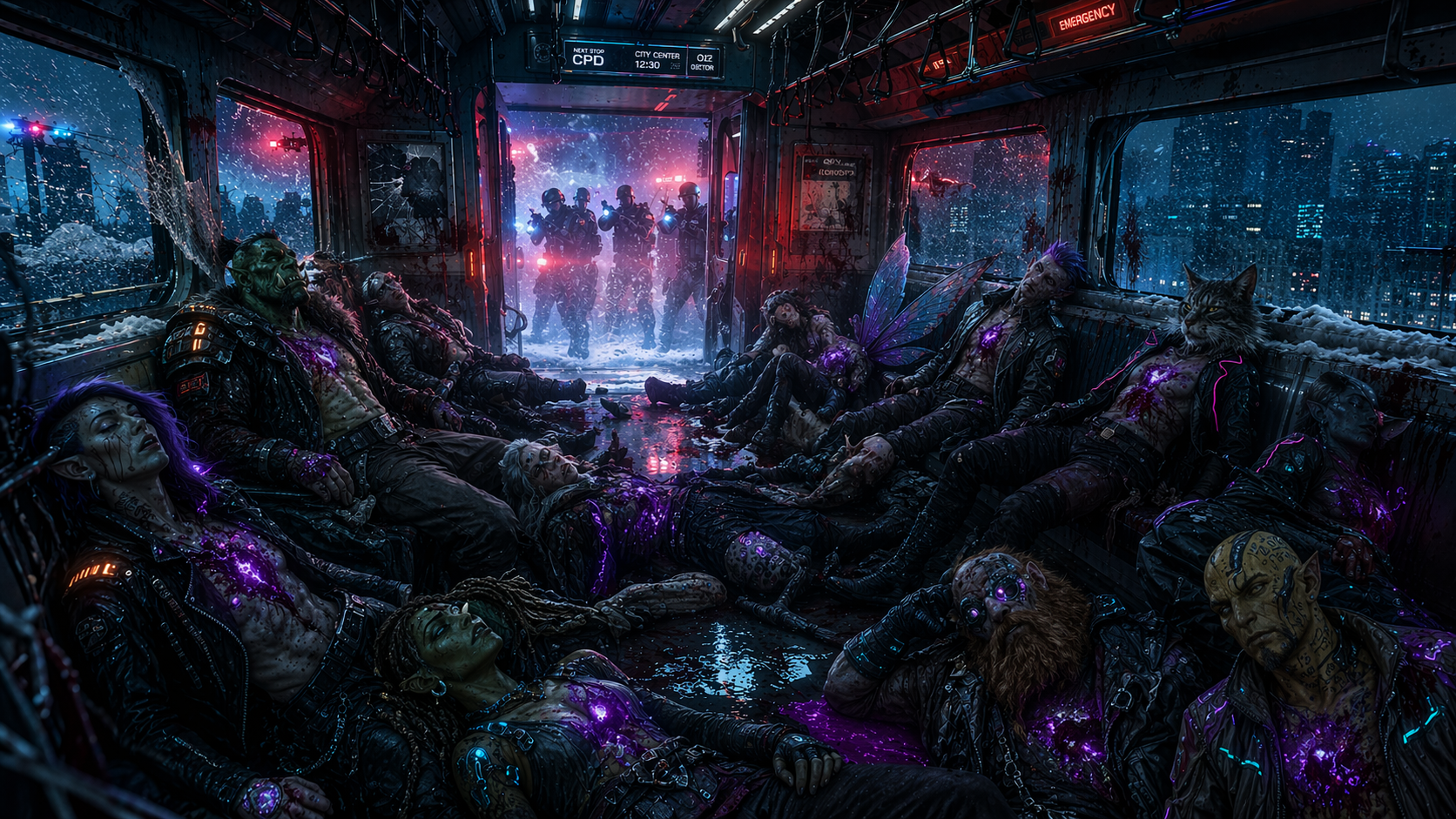
    Once the party finally reached Spine Terminal, bloodied but victorious, they were immediately shoved into a live press conference mini-game that I mocked up myself.

    And suddenly the campaign changed genres.

    Instead of initiative order and damage rolls, we shifted into a hybrid roleplay and skill-check sequence where every answer mattered. The city wanted to know what happened aboard the train. The media wanted either heroes or villains. The corporation running the Aurora Line wanted liability control.

    And the party?

    The party had just violently killed over 100 infected passengers in public.

    I designed the press conference as a branching narrative pressure point:

    • fail checks
    • roleplay poorly
    • contradict each other
    • appear unstable
    • or admit too much…

    …and the city could very realistically decide they were the villains.

    Corporate investigations. Arrests. Detainment. Public outrage. Surveillance.

    The players immediately understood the stakes.

    And to their credit, they absolutely crushed it.

    Somehow this exhausted group of near-murderhobos managed to come across as reluctant heroes instead of cyberpunk war criminals. The public bought it.

    Mostly.

    The corporation running the train certainly didn’t.

    Now the players are on their radar.

    Which, honestly, is probably worse.

    After the conference ended, the entire tone of the campaign shifted again.

    The party rode out into the endless neon night on rented bikes, finally leaving the structured rails of the opening arc behind. They crossed into The Lantern Docks, the first true sandbox district of the campaign, and arrived at The Allfather’s Rest:
    a cyberpunk tavern wrapped in the illusion of a fantasy inn, run by an omnipresent AI named Odin.

    Think Poe from Altered Carbon if he inherited a Norse mythological obsession and a deeply unsettling level of emotional intelligence.

    That was the moment the campaign finally exhaled.

    Players explored. Talked. Reflected. Drank. Questioned each other. Investigated the tavern. Watched impossible Nordic landscapes shift behind the “windows.” Began realizing the world was stranger than they thought.

    And most importantly:
    every player received their first truly personal magical item.

    Not through loot tables.

    Through moments.

    Two of them earned theirs during the ride into The Lantern Docks. Another through a conversation inside the tavern itself. One of them received theirs in their sleep through a moment that quietly hinted at a truth the party still doesn’t understand:
    she isn’t human.

    She’s an AI living inside a synthetic body.

    The party doesn’t know yet.

    And that’s the kind of tension I’m starting to realize matters far more than whether my train zombies landed their attacks.

    The combat failure still taught me an important lesson.

    But the session itself reminded me of something bigger:

    The moments players remember most are rarely the encounters you balanced perfectly.

    They’re the moments where the world reacts to them in ways they didn’t expect.

  • I Started My D&D Campaign Without a BBEG

    We are currently six hours into this campaign.

    Two sessions. One train. We still haven’t finished the opening encounter.

    And somehow, despite all of that time spent inside a single moving metal corridor beneath the Icelandic aurora, my players are already convinced there’s some enormous hidden conspiracy unfolding beneath the surface of the world. They’re analyzing dialogue, theorizing about corrupted arcane systems, questioning corporate motives, and trying to determine which NPCs are secretly important. Every strange detail immediately becomes evidence in their minds that there’s a larger machine operating underneath the campaign.

    Here’s the part I probably shouldn’t admit publicly:

    I still don’t actually know who the main villain is.

    Not vaguely. Not secretly. Not in a “wait until the reveal” kind of way. I genuinely do not know yet.

    And for a while, that terrified me.

    When I first decided to DM, I made the completely reasonable decision to ignore every sane beginner path available. I’m a month into it now and have watched countless TikTok and Reddit posts about how you shouldn’t use the D&D system to make a Cyberpunk world when there are already multiple systems that work perfectly — not to mention the Cyberpunk ttrpg itself. I’ve never been much of a rule follower so I instead build an entirely homebrewed cyberpunk fantasy world in D&D from scratch. Not just a setting either. A functioning ecosystem. Custom mechanics. A fully simulated economy. A stock market. Megacorporations. Transit systems. Arcane infrastructure. Political tensions. Altered weapons. District maps. Social systems. Black market economies. Ancient magical instability buried beneath futuristic architecture. Basically the tabletop equivalent of deciding your first driving lesson should happen during a Formula 1 race in the middle of a blizzard.

    And somehow, through all of that obsessive preparation, there was still one glaring hole sitting at the center of the campaign:

    I had no idea who the BBEG was.

    That felt wrong. Not creatively wrong. Structurally wrong. Every piece of DM advice online seems to imply that a “real” campaign starts with a fully established antagonist. Introduce the villain early. Foreshadow constantly. Build toward a final confrontation. Know your ending, or at least a possible one, before Session One begins. Traditional storytelling logic trains us to believe that the narrative spine has to be established immediately or the whole thing collapses into chaos.

    So naturally, I assumed I was failing some invisible competency test before the campaign had even started.

    But the deeper I get into running this world, the more I’m beginning to realize something uncomfortable and strangely liberating at the same time:

    I don’t think the campaign actually knows what it’s about yet.

    Not fully.

    I know the world. I know the tone. I know the pressure systems operating beneath the surface. I know that Reykjavík in 2136 is balancing itself on top of unstable arcane infrastructure while corporations siphon auroral energy they barely understand. I know there are ancient forces hidden beneath modern expansion and that technology has evolved alongside magic in ways that feel spiritually dangerous. I know the setting’s themes. I know the atmosphere. I know the emotional texture I’m chasing.

    But I still don’t know what this story becomes once the players start colliding with it long enough to leave scars.

    And honestly, I think that uncertainty is beginning to matter more than certainty ever could.

    Because tabletop storytelling is fundamentally different from writing a novel. A novel is controlled. A campaign is discovered. You can build all the infrastructure in the world, but eventually the players start applying pressure in directions you never anticipated. They latch onto NPCs you invented in thirty seconds utilizing a Tiefling name generator you found online. They become emotionally attached to random environmental details. They ignore carefully planted hooks and become obsessed with something you thought was flavor text. The campaign starts mutating in real time.

    That’s exactly what’s happening now.

    The players think they’re uncovering hidden narrative threads. In reality, I’m quietly watching to see which threads become important through their attention. And the fascinating part is that the campaign already feels coherent enough that they assume there’s a master plan behind everything. They trust the world. That trust creates the illusion that every mystery already has a definitive answer waiting behind the curtain.

    Sometimes it does.

    Sometimes I’m discovering the answer five minutes before they do.

    The strange thing is that I no longer think this is a weakness.

    In fact, I’m starting to suspect forcing a fully defined villain too early might have actually damaged the campaign.

    Because once a DM decides “this is the villain,” there’s an unconscious temptation to begin protecting the outline instead of exploring consequences. The world becomes less reactive. Emergent moments become harder to follow because the narrative has already calcified around predetermined structure. You stop discovering the campaign and start managing it.

    I don’t want that.

    I want the world to breathe.

    I want recurring NPCs to become important naturally. I want betrayals to emerge from emotional pressure instead of outline planning. I want the players’ choices to reshape the direction of the narrative instead of simply moving them through a sequence of prebuilt revelations. Most importantly, I want the eventual antagonist to feel inevitable in hindsight rather than assigned during prep.

    And I think cyberpunk as a genre actually thrives under that philosophy.

    Cyberpunk stories rarely revolve around singular evil masterminds sitting in volcano lairs waiting for the heroes to arrive. The antagonists are usually systems. Infrastructure. Incentives. Corporate machinery. Economic pressure. Surveillance normalized into everyday life. Technological dependence quietly consuming humanity beneath neon spectacle. Sometimes the villain isn’t even a person when the story begins. Sometimes it’s momentum. Sometimes it’s the world itself accelerating toward collapse while everyone inside it keeps pretending things are stable, which feels a little bit like our world now.

    That’s why I’m no longer panicking about not having a perfectly defined Big Bad Evil Guy after two sessions.

    The campaign is still in its ignition phase. The players are still revealing who they are. I’m still learning what actually frightens them, what fascinates them, what they distrust, and what they’re willing to risk themselves for. Those emotional patterns matter more than any lore document I could’ve written before Session One ever started.

    And honestly, the fact that we’ve spent six hours inside a single encounter without the table collapsing into boredom tells me something important is already working. The pacing absolutely needs refinement. I’ve already started realizing the difference between cinematic scale and table velocity, and there are structural changes I’ll make moving forward. But emotionally, the players are invested. They’re theorizing. They’re immersed. They’re treating the world like it contains hidden truths worth uncovering.

    That’s the real foundation of a long campaign.

    Not perfect plotting.

    Belief.

    The funny part is that my players probably think I’m sitting behind the screen orchestrating some massive multi-layered narrative web with absolute certainty while I quietly nod and take notes like:

    “Interesting. That actually would make a terrifying villain.”

    And maybe that’s what DMing really is sometimes.

    Not controlling the story.

    Just staying one step ahead of discovery long enough for everyone at the table to believe the world was alive before they arrived there.

  • Building a Cyberpunk D&D World Almost Broke My Brain

    When I first decided to DM, I made a very dangerous mistake:

    I treated the words “homebrew setting” like a challenge instead of a warning label.

    Most people start with:

    • a town,
    • a few NPCs,
    • maybe a modified subclass,
    • and a dream.

    I apparently decided to start with:

    “What if I built a fully simulated cyberpunk civilization powered by arcane energy and then forced myself to learn how to run it in real time?”

    So naturally, that became the project.

    Not just lore.
    Not just aesthetics.
    Infrastructure.

    I wanted the world to feel systemic.

    Not “video game cyberpunk.”
    Not neon wallpaper stretched over medieval fantasy.
    A living ecosystem where:

    • megacorporations monopolized magical resources
    • economies fluctuated
    • transit systems mattered
    • districts had political identities
    • geography shaped culture
    • and technology evolved through magic instead of replacing it.

    The deeper I got into building the world, the more I realized something:

    Players can instantly tell the difference between a setting that was invented and one that was considered.

    That realization completely changed how I approached campaign prep.

    Instead of designing isolated set pieces, I started designing interfaces, transit systems, media feeds, corporate ecosystems, and public infrastructure. I even went on an ADD side quest spending a few hours designing a functioning stock market system in Excel that responds to what the players are doing in the world. I wanted players to feel like they had entered a world already in motion before their characters ever existed inside it.

    That philosophy is what led to some of the visual systems I’m probably most proud of so far.

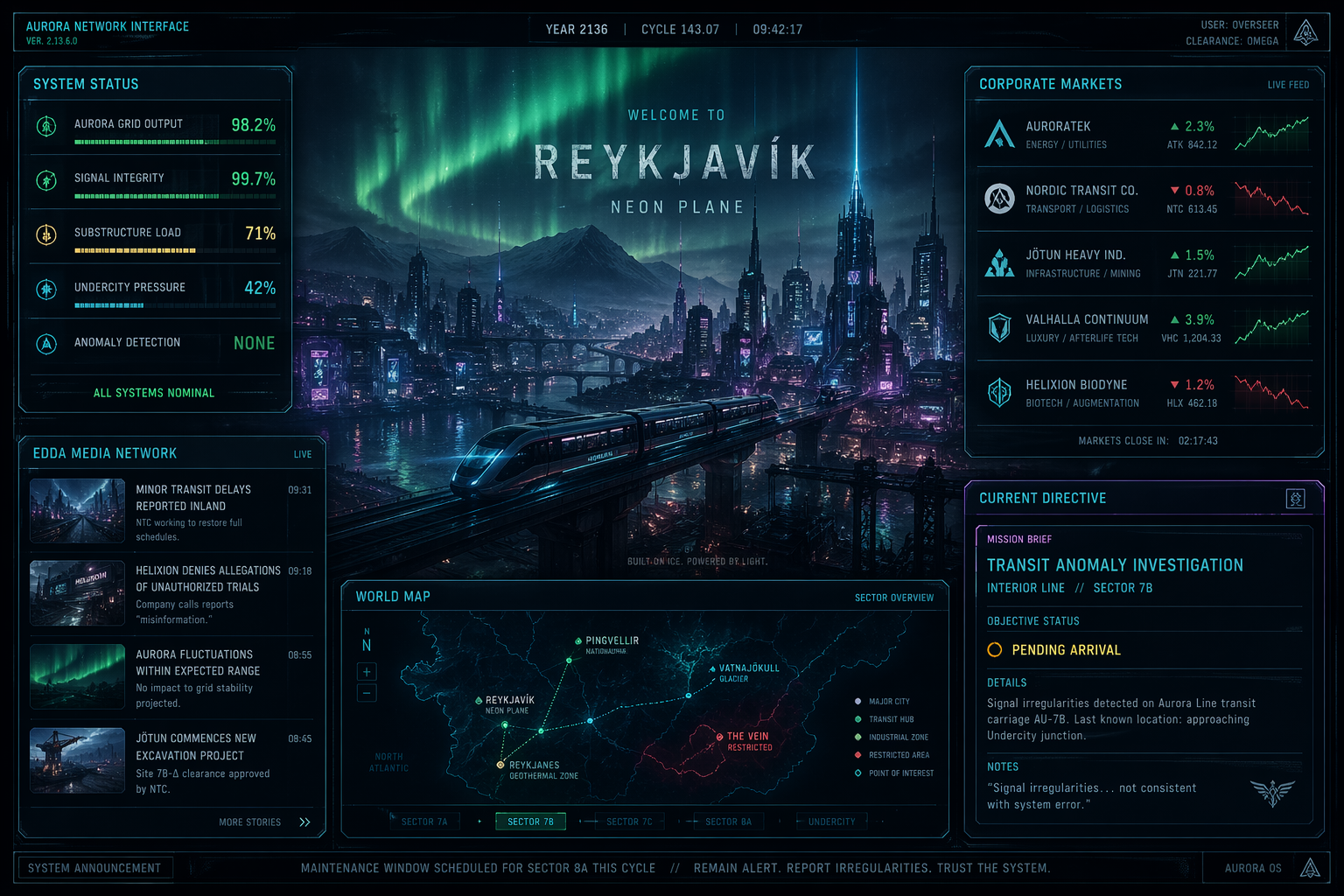
    Futuristic digital interface for Aurora Network, featuring a neon-lit cityscape of Reykjavík with green auroras in the sky, system status details, corporate market updates, live media news, and a world map highlighting transit routes and anomalies.

    The first major breakthrough was building the actual world interface for Reykjavík itself.

    This was the moment the setting started feeling real to me.

    Not because the graphics looked polished, but because the interface implied systems beyond the players’ immediate perspective:

    • market fluctuations
    • transit anomalies
    • corporate influence
    • infrastructure strai,
    • hidden instability beneath “ALL SYSTEMS NOMINAL.”

    That last part became extremely important philosophically.

    Cyberpunk worlds should always feel like they’re smiling while actively bleeding internally.

    The next thing I became obsessed with was player presentation.

    I didn’t want the party to feel like disconnected fantasy archetypes awkwardly standing next to each other. I wanted them to feel like registered entities inside a monitored network ecosystem.

    So I built an active entity roster for the campaign.

    Digital display featuring an active entity roster for the Aurora Network, highlighting vibrant characters in a cyberpunk setting.

    This ended up doing something I didn’t fully expect:
    it psychologically unified the party before the campaign even began.

    Suddenly the players weren’t just “a D&D group.”

    They were:

    • tracked,
    • categorized,
    • monitored,
    • and surviving inside a hostile system.

    That subtle framing matters.

    Then came the maps.

    A detailed map of a fictional landscape featuring various regions labeled, including 'The Neon Fjords,' 'The Storm Scar Highlands,' 'The Sovereign Zones,' and 'The Glacial Expanse.' The map is artistically designed with distinct colors representing each area.
    A stylized map of Reykjavik divided into various districts, featuring neon colors and digital design. It includes notable areas such as VESTURHÖFN, NORÐVIK, and GRÁHVĒRFI, complemented by a district key and a description of the city.

    And honestly, the maps are where the project stopped feeling like campaign prep and started feeling like world archaeology.

    I didn’t want regions to exist just for biome variety. I wanted geography to imply history, resource distribution, political fragmentation, and mythological contamination.

    So Iceland slowly evolved into this fractured neon wasteland of sovereign territories, industrial scars, geothermal infrastructure, frozen expanses, and corrupted regions bleeding with arcane instability.

    The city map of Reykjavík became even more obsessive.

    Because districts tell stories before NPCs ever do.

    You can immediately understand a city by:

    • what it protects
    • what it hides
    • where wealth accumulates
    • where infrastructure decays
    • and where people disappear

    I wanted every district name to sound like it had survived decades of corporate pressure, economic adaptation, and cultural mutation.

    Even the transit system became part of the storytelling.

    A futuristic cityscape at night featuring a sleek train traveling over a bridge, with vibrant neon lights and digital billboards illuminating the skyline, alongside the northern lights in the sky.

    The Aurora Line wasn’t just transportation. It became symbolic:
    a gleaming artery carrying people through a civilization quietly destabilizing beneath the surface.

    Which is why the train imagery mattered so much to me.

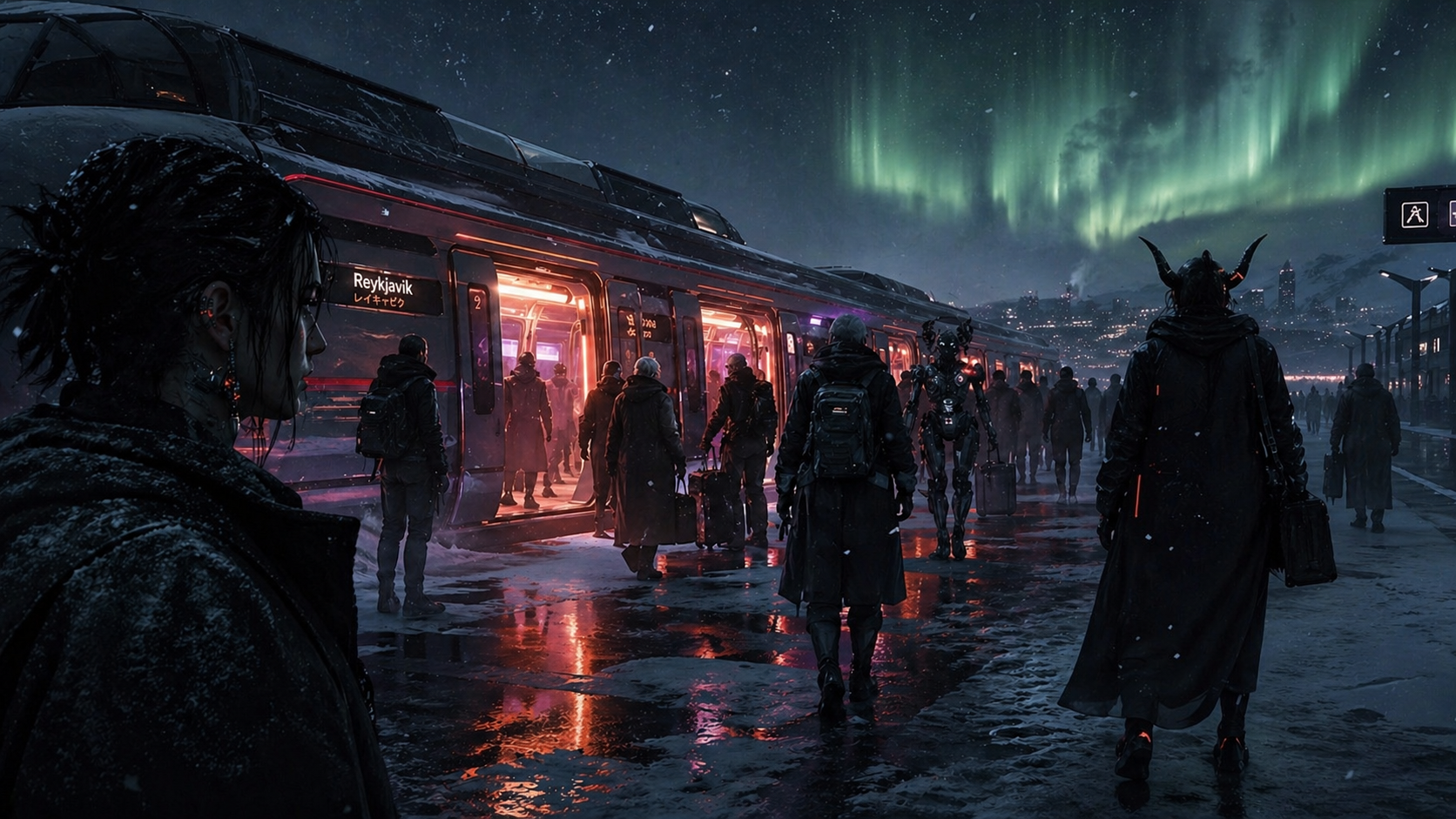
    And finally, the airport.

    Futuristic airport scene featuring various humanoid figures with sci-fi elements, illuminated by colorful lights and an aurora borealis in the sky, with digital screens displaying flight information.

    This image might actually represent the entire campaign philosophy better than anything else I’ve made.

    Because that’s the world in one frame:

    • fantasy races
    • impossible technology
    • cold industrial infrastructure
    • commercialization
    • surveillance
    • mythology
    • and wonder existing simultaneously

    The more I build this campaign, the more I realize worldbuilding isn’t really about “creating content.”

    It’s about creating continuity of belief.

    Every screen, map, corporation, transit line, stock ticker, district, and visual element exists to answer a subconscious player question:

    “Does this world continue beyond the edge of the camera frame?”

    That’s the threshold I’m chasing.

    The moment where players stop interacting with a campaign…

    …and start inhabiting a civilization.

  • Session 2 – Cinematic Scale vs Table Velocity

    I just learned the first problem every ambitious DM eventually collides with:

    Cinematic Scale vs Table Velocity

    I wanted my encounter to feel overwhelmingly unfair. Seven players trapped on a moving train, staring down what looked like certain death. When I revealed the battle map at the end of Session 1, the reaction was exactly what I hoped for. Memes started appearing in Discord almost immediately. Players were joking about preparing backup characters before the fight had even begun.

    That tension was the goal.

    The mistake I made was softening it too early.

    I gave the party a surprise round to start cutting into the enemy count before the combat properly began. In hindsight, I probably didn’t need to. I already had multiple contingency valves prepared if things became truly catastrophic. Then, during the fight, I narrated a missed attack cracking one of the train windows, which our Paladin immediately exploited by hurling a suitcase through it and using the pressure differential to wipe out several enemies at once.

    It was cinematic. It was memorable. It was exactly the kind of emergent gameplay I want to reward.

    But combined with the surprise round and a later civilian stampede that flattened another cluster of enemies, the encounter lost too much mass too quickly. The players never had enough time to fully absorb the feeling of being trapped inside the danger before the danger started collapsing around them.

    That’s the balancing act I’m beginning to understand:
    not how to make encounters deadly,
    but how to make them linger.

    The original design was 26 pressure units, not 26 true combatants. Their purpose was to create saturation, chaos, and the sensation of being overwhelmed. Mechanically, that part worked. Emotionally, though, the atmosphere shifted the moment the players subconsciously realized:

    “These enemies exist to die.”

    Once that realization sets in, tension changes shape. Survival horror becomes target practice with dramatic lighting.

    The other major lesson was pacing.

    The combat took a little over two hours, even with me moving quickly through enemy turns. Most enemies only consumed fifteen or twenty seconds individually, but scale changes the math. Twenty-four fast turns are still twenty-four turns. Eventually the rhythm became:

    DM speaks → dice roll → DM speaks → dice roll → DM speaks → dice roll.

    The players weren’t bored because the turns were slow. They were bored because the structure fragmented attention into too many procedural moments. They became spectators in my physics engine when what I really wanted was simultaneous catastrophe.

    Especially in cyberpunk.

    Cyberpunk combat should feel volatile, asymmetrical, and unstable. It should feel like the environment itself is trying to kill you. A moving train full of terrified civilians shouldn’t behave like static terrain. It should feel reactive and dangerous enough that the battlefield becomes part of the narrative.

    Which is why the shattered train window worked so well.

    The lesson isn’t “don’t reward environmental creativity.” If the environment never matters, the battle map is just decorative geometry. The real lesson is that every environmental interaction has a pressure value. The cracked window was good. The civilian stampede was good. The surprise round was probably fine. But layered together, they compressed the tension curve too aggressively.

    I think the future solution is squad-based combat.

    Instead of 26 independent enemies, the encounter could have been structured as four coordinated waves supported by two mini-bosses. Shared initiative. Shared movement. Shared attacks. Enemies functioning as suppressive pressure instead of individual bookkeeping entries.

    Not only would that dramatically improve pacing, it would also improve texture.

    And ultimately, that’s the real realization I’m taking away from this session:

    Encounter badassery is not proportional to combat duration.

    Players don’t remember enemy #17 hitting them for 3 damage. They remember impossible decisions, nervous laughter, collapsing momentum, clutch rolls, sacrifices, and the moment the train window shattered open into the frozen night.

    That’s the feeling I’m chasing.

  • Session Session 1 – Building a Cyberpunk D&D World That Felt Real

    A few months ago I made what, in hindsight, was an almost absurd decision:

    I decided that if I was going to DM for the first time, I wasn’t going to run a prewritten module.

    I was going to build an entire world from scratch.

    Not just a setting. A functioning ecosystem.

    I wanted a version of D&D that felt genuinely cyberpunk instead of simply reskinning fantasy races with neon lights duct-taped onto them. I wanted a world where magic had evolved alongside technology instead of existing separately from it. A world where megacorporations exploited arcane energy the same way modern companies exploit oil, electricity, and data. Where ancient runes were integrated into circuitry. Where the economy itself reflected the setting’s logic.

    So I built one.

    A fully homebrewed world.
    Custom systems.
    Modified mechanics.
    A functioning economy.
    A fluctuating stock market.
    Black market infrastructure.
    Custom corporations.
    Cybernetic augmentation systems.
    Arcane engineering.
    Altered weapon mechanics.
    New currencies.
    New lore.
    New tensions.

    And because I apparently enjoy suffering, I decided to do all of this while simultaneously learning how to DM.

    Looking back now, I think part of the reason I committed so hard to the worldbuilding was because I understood something intuitively before I understood it mechanically:

    If the world felt real enough, the players would forgive the friction of learning it.

    Session One proved that instinct was correct.

    Before we even started the actual game, I showed the group the visuals I’d been building for the campaign. Character art. Environmental shots. Interface graphics. Cityscapes. Neon-drenched Icelandic skylines fused with arcane symbolism and industrial futurism. There’s a noticeable difference between people politely complimenting creative work and people emotionally buying into a world. The “holy shit” reactions weren’t really about image quality. They were about coherence. Suddenly the setting felt tangible.

    That mattered because the intro narration depended entirely on atmosphere and trust.

    I wanted the opening to feel cold, cinematic, and slightly sacred. Not exposition-heavy. Not lore dumping. Just immersion. Frozen tarmac beneath the aurora. Neon runes suspended in the winter air. Travelers existing inside a society where magic and technology had become inseparable from daily life. A world where the extraordinary had become mundane.

    The biggest thing I learned was how powerful restraint can be.

    I didn’t start the campaign with explosions or combat. I started with subtle wrongness:

    • a passenger whose expression lingered unnaturally,
    • aurora light bending in ways it shouldn’t,
    • arcane energy that felt unstable beneath the surface.

    Just enough distortion to activate instinct without immediately explaining itself.

    I think that’s what made the setting feel believable. The world wasn’t screaming:

    “LOOK HOW DARK AND COOL THIS IS.”

    It behaved as though it already existed before the players arrived.

    And then something happened that I honestly wasn’t expecting:
    even while learning the system, the players stayed emotionally engaged.

    This was not a veteran table running optimized turns with encyclopedic rules knowledge. We had:

    • two completely new D&D players,
    • multiple people learning new classes,
    • an entirely new Foundry VTT setup,
    • homebrew mechanics,
    • altered systems,
    • and me learning how to manage all of it in real time.

    Combat in the first train car was objectively slow by experienced-table standards. But it never felt dead. Everyone was discovering the system together. Players were figuring out their abilities in real time, learning action economy, understanding reactions, testing movement, experimenting with spells, and trying to understand how their characters actually functioned inside the world.

    And somehow, the tension survived all of that friction.

    That was probably the biggest revelation of the night.

    The players trusted the world long before they fully understood the mechanics.

    The first combat encounter ended up becoming an accidental tutorial in stakes. One player got dropped to 0 HP during the fight before our Bard pulled them back up with Healing Word a few turns later. In retrospect, I think that moment was perfect for Session One. Dangerous enough to establish consequences. Recoverable enough to avoid creating fear paralysis.

    The table learned something important in that moment:
    this world bites back.

    But it is not arbitrarily cruel.

    That distinction matters.

    What also worked surprisingly well was the progression of escalation. The first train car felt tense but manageable. The players were under pressure, but they still felt agency. Then they moved into the second car and encountered something much larger, much more chaotic, and much more psychologically overwhelming.

    That’s where I ran headfirst into the next major lesson:
    the collision between cinematic scale and table velocity.

    But honestly, that realization belongs to Session Two.

    What Session One taught me was something more foundational:

    Immersion is not created by mechanics alone.
    It’s created when players believe the world exists independently of them.

    If they believe that, they’ll tolerate slower combat.
    They’ll forgive imperfect pacing.
    They’ll stumble through rules.
    They’ll stay curious through confusion.

    Because emotionally, they’re already inside the train.

  • I didn’t start my day today thinking that I was going to be building a website.

    For a long time, most of what I worked on lived in pieces—ideas half-written, projects started and left open, things I’d spend time on without ever really documenting or organizing them, and it wasn’t due to a lack of interest or effort. If anything, it was the opposite. I’d get pulled into something, go deep on it, then move on to the next thing that felt worth figuring out.

    Over time, that started to feel incomplete.

    Not because I needed everything to be polished or finished (okay, maybe a little bit of that is true), but because there was no record of how things were actually developing. No place to track what worked, what didn’t, and what changed along the way. Everything existed in isolation.

    This is an attempt to fix that.

    Not by forcing structure onto everything or pretending I’m suddenly going to be hyper-organized, but by giving things a place to land. Somewhere to track what I’m working on while I’m in it, not just after it’s done or forgotten.

    This is more or less going to serve as that giant whiteboard I always wanted but could never justify once I thought about how much it would ruin the aesthetic of my home. Fun fact—I still have a three-inch binder overflowing with drawings, writing, poems, quotes, hand-drawn engineering models, and a deep dive into the effects of MSG on the body. (Maybe I’ll post some things from that one day…)

    I tend to move between things that hold my attention. Sometimes that’s building out characters for D&D or working through a campaign I keep telling myself I’ll actually run once I get over the idea that it has to be great and find enough responsible people who will consistently show up. Other times it’s refining a recipe, dialing in a photo, or trying to understand how a new tool actually works beyond the surface level. The medium changes, but the pattern doesn’t.

    Up until now, all of that has mostly lived in my head or scattered across notes, messages, and half-finished drafts. There hasn’t been a central place to see how those things connect or evolve over time.

    That’s what this is.

    Not a finished product. Not a portfolio. Not something cleaned up and presented like it all came together neatly.

    Just a place to work through things as they happen.

    Some of what ends up here will be more complete. Some of it won’t. There will be things that change, things that get dropped, and things that stick around longer than expected. That’s part of the process, whether it’s documented or not, so it might as well be visible.

    Right now, there are a handful of things already in motion. This site is one of them. A recipe book that’s slowly taking shape. My first D&D campaign, being built out piece by piece. Ongoing experiments with photography and AI tools that I’m still trying to fully understand.

    None of those are finished. That’s kind of the point.

    This just gives them somewhere to exist while they’re becoming something.